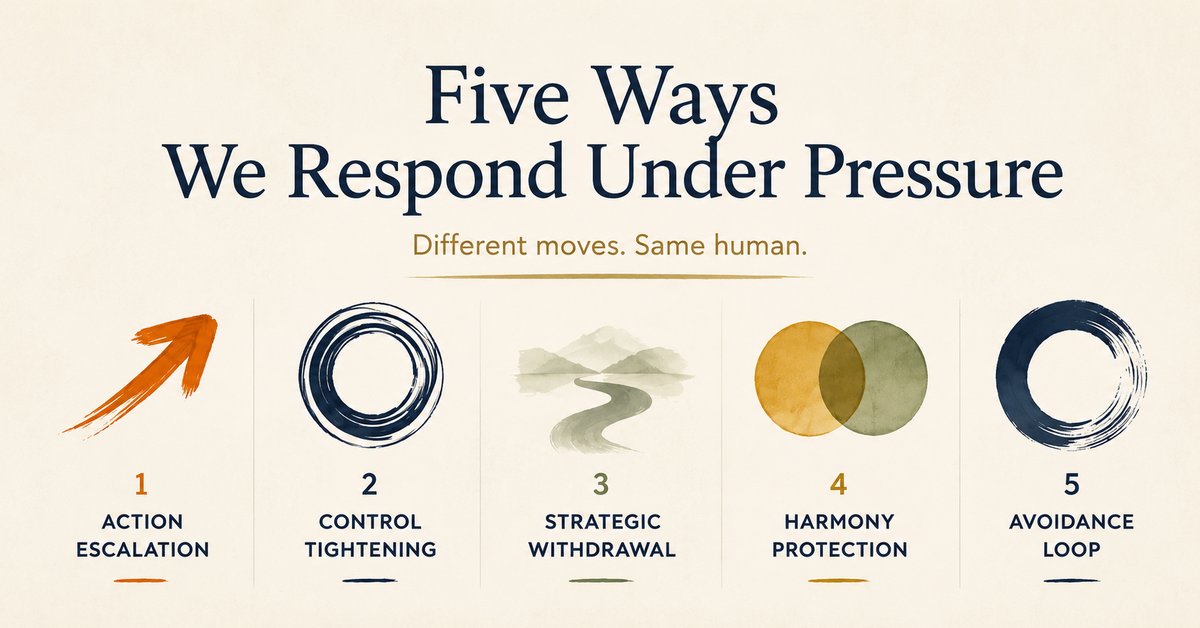
Five Ways We Respond Under Pressure
Pressure doesn't give us a new personality. But it can change which responses feel most available to us.
A useful leadership capacity can start doing too much work. Decisiveness becomes taking over. Oversight becomes control. Reflection becomes distance. Keeping things steady can suppress necessary tension. Stepping away can become disengagement.
I call these pressure patterns.
They aren't personality types, and none of them is inherently a problem. Each begins with a capacity we need. The question is what happens when that capacity becomes the move we keep reaching for — and what becomes harder to access when it does.
1. Action Escalation
Something needs to happen, so you move.
You decide. Fix. Answer. Take something back. Get the work moving.
That capacity matters. But under pressure, movement itself can become the priority. You start doing work that should remain with other people. Decisions migrate toward you. Patience gets shorter, and trusting other people to carry something gets harder.
The interruption question:
Who should own this?
2. Control Tightening
This can look remarkably similar to Action Escalation from the outside. In both cases, you may appear to grab the wheel.
But the underlying move is different.
Action seeks movement. Control seeks certainty.
You check more closely. Specify more precisely. Ask for another update. Become less comfortable allowing someone else to determine how an outcome will be reached.
Oversight is part of good leadership. The pressure pattern appears when letting go — and trusting an outcome you didn't shape yourself — becomes difficult.
The interruption question:
What outcome are we aiming for?
3. Strategic Withdrawal
Sometimes the move under pressure is to create more space to think.
You step back. Consider more angles. Resist declaring a direction before you understand what's happening.
Reflection can protect us from impulsive decisions. But it can also keep expanding while other people are waiting for direction. The cost is not reflection itself. It's when decisiveness and presence become harder to reach.
The interruption question:
What is the next move we can test?
4. Harmony Protection
Some of us become particularly attentive to stability and relationships under pressure.
You notice tension. You understand competing perspectives. You know that forcing an issue can damage trust.
But preserving stability can make it harder to let useful tension stand. The difficult point gets softened. A disagreement remains implicit. Everyone can leave a meeting apparently aligned while the thing that needed saying remains unsaid.
The interruption question:
Is there something here that has not been voiced yet?
5. Avoidance Loop
Sometimes engagement itself starts to reduce.
Attention moves toward safer ground. The difficult conversation fades. Something everyone knows about somehow stops appearing on the agenda.
This is importantly different from Strategic Withdrawal. Withdrawal creates distance in service of returning. In an Avoidance Loop, entering or sustaining contact with the difficult thing is itself becoming harder.
The interruption question:
What has gone quiet that shouldn't have?
The point isn't to find your type
You may recognise yourself in several of these. That's entirely compatible with the idea.
These are capacities, not categories of people. We need the ability to act, direct, reflect, preserve relationships and disengage.
The useful question is what happens to that range under pressure.
Which move becomes especially available — and what becomes harder to do when it does?
That's where recognising a pressure pattern can become useful: not as a label, but as something you can learn to catch and interrupt.
Noam Gamady
Certified Feldenkrais Practitioner, Reiki Master, and NVC trainer with 15+ years helping executives lead from the body, not just the mind. Based in New York City.
You Might Also Like

When the Doing Becomes the Problem
How pressure quietly pulls leaders out of leadership and back into the work Bruce knew the Q3 deliverable was slipping. He could feel it, not in the data yet, but in the way his mornings were filling

Active Listening Skills: The Leadership Communication Skill That Transforms Teams
Master active listening skills to transform workplace communication and leadership effectiveness. Practical techniques and real examples from an executive communication coach.

Why Your Team Needs Psychological Safety (And How to Build It)
Google is Project Aristotle proved psychological safety is the #1 predictor of team performance. Learn how to build it in your organization.